The Network

The Network
This blog is no longer updated. Please click the picture to hop across to The Network
Showing posts with label Melbourne. Show all posts

Wednesday, January 16, 2008

Praying for Melbourne 2008

Archbishop Philip's Prayer for Melbourne
God of community, we give you thanks
for this beautiful and vibrant city:
for its diversity of people and cultural life,
for its industry and commerce,
for its hospitals and agencies of care,and
for its places of learning, recreation and worship.

God of compassion,we pray
for all who live and work in this city and
for those who visit here:
open our hearts to welcome the stranger,
shelter the homeless,befriend the lonely,care for the needy, and
offer hope to those in despair,
for these are your people.

God of community, Giver of life, of love and hope,
hear our prayers for the welfare of this city.
Amen


Translation: God of compassion - you are here 24 hours a day, seven days a week. You are at home, at school, at work with all generations. Thank you. Lord help me to care for others. For they are your people, Amen.

~~~~~~~~

We are a large and dynamic faith community in one of the world's most multicultural cities. We are diverse and vibrant and our parishes and other ministries cater to a wide variety of expressions within the Anglican tradition of the Christian faith. We trust that you will find resources, support and inspiration on our website to help you with your faith journey.

Dr Philip Freier, Archbishop of the Anglican Diocese of Melbourne

Monday, December 17, 2007

The Archbishop and Childhood Depression

Please sign the Archbishop's Petition.


It is just over twelve months since Philip Freier was installed as Archbishop of Melbourne. Miss Eagle is unable to comment on whether Ab Philip is a good administrator of the affairs of the Archdiocese. She is also unable to comment on what sort of guidance, counsel and spiritual leadership the Archbishop provides to the clergy and laity. However, there is no gainsaying the public leadership provided by the Archbishop in 2007. It has been constant and remarkable.

He began with his Prayer4Melbourne quest. This twelve month program has seen the Archbishop out and about in all sorts of places and settings meeting all sorts of people. This has promoted awareness of Melbourne not only for the Archbishop, a newcomer to Melbourne, but within the Anglican constituency itself. The quest has also given the Archbishop and the Anglican community an enlarged profile in Melbourne.

In tandem with the quest, has been Conversations with the Archbishop. The conversations, which are held at BMW Edge in Federation Square, have received great attention and interest. The quality of the speakers has been excellent. The Archbishop has handled his role well.

[A small contingent from St Thom's at Upper Gully will be fronting up to this Wednesday's conversation with Hugh McKay. This is no mean feat because none of us are young and we will be catching the 6.32am train. This will get us there a few minutes late, Archbishop, but we'll be there with our Christmas bells on!]

One exercise of communal and Christian leadership was the Archbishop's address in reply to Patrick Dodson's speech in Brunswick in October. It was a tour de force.

One of the Archbishop's conversations focussed on childhood depression when, on November 14, he held a public conversation under the title Our crisis of childhood depression. Ab Philip was joined by the Director of Women's Forum Australia, Melinda Tankard Reist, and Professor Alasdair Vance, the Head of Academic Child Psychiatry, Department of Paediatrics, University of Melbourne. The Archbishop has called for a national inquiry into the state of childhood in Australia. He has renewed his call to-day in The Age.

Archbishop Philip has highlighted Mission Australia's 2007 Survey of Australia's Young People. Read of its major findings here.

Thursday, November 08, 2007

Horses - their Cup runneth over?

Bay Story crashing through the rails at Flemington on Melbourne Cup Day 2007.
Bay Story was later destroyed: his loss of life another casuality of horseracing.
Photo: Getty Images published in The Age


The first Tuesday in November in Australia is the day when Australians stop for a horse race - the Melbourne Cup. This Melbourne Cup Day, at Flemington in a race preceding the Cup, a horse was destroyed.
The following story is from Crikey
The other - ugly - side of the sport of kings


Animal Liberation's Elio Celotto writes:


The horse racing industry in Australia is an extremely powerful and profitable business sector employing an estimated 132,000 people and making up 0.5 of our GDP. But is it ethical?


Each year the Australian horse racing industry produces approx 18,000 foals. However, only approx 30% will ever race. The majority are rendered worthless at a very young age. Well almost; they are after all "horse flesh" a term coined by the Racing Industry. And "horse flesh" is what these horses become. There is no sentiment for a racehorse that can’t run. Most are sold for a few hundred dollars; their final destiny, a European dinner plate or a can of dog food.


What about the racehorses that do race? In training, most racehorses spend up to 22 hours per day in a solitary stall. As a result of this confinement, most will develop neurotic behaviour.
As a result of not being able to continually graze which horses need to do to neutralise stomach acids, 90% will suffer from stomach ulcers. Nearly all horses will suffer from pulmonary bleeding (bleeding of the lungs) as a result of being forced to continually over exert themselves.
Contrary to what the industry will tell you, horses do not love to race. If they did, why are they whipped. Or do they love that too? Electric devices called "jiggers" are also sometimes used in training to force the horse to race on command.


The average racing career is less than 3 years. Why so short?


Owners want a return on their investment as soon as possible so most horses start racing as 2-year-olds despite the risk of injury. In human years, this is equates to a 15-year-old child. The musculo-skeletal structure of the thoroughbred horse does not fully develop until 4-5 years of age.
Eventually, virtually all horses succumb to injury and/or one or more of the many chronic conditions caused by their training regime and racing. When this occurs, ending their racing career, the high cost of keeping a horse means it makes commercial sense to "get rid of it".


Only a few will go into breeding and even then, they are only replacing existing mares and stallions which have declined in number by 20% in the last 5 years.


To exploit animals for human entertainment and keep them in conditions which can only be compared to a gaol, is abhorrent and a blight on our society which not only condones it, but supports it.

Sunday, October 21, 2007

Kath and Kim: tunnelling through


It is nearly ready! Melbourne's latest Freeway - the Mitcham to Frankston or the Scoresby as it is often known. It is only ten minutes from Upper Gully and Miss Eagle will probably love its convenience. Shame on me - as I remember the beautiful farmland it subsumed - including a place with miniature ponies.
Herself can be a clever drawers at times and - as soon as she heard the announcement - she had the names: Kath and Kim.
I don't think the names are worth entering because you see, dear Reader, there are guidelines. And, after a read of those, it seems that Kath and Kim may not cut the mustard.
But that, dear Reader, should not really matter. The tunnels can have a flash, guide-line meeting name for the toffs. But for the rest of us we know that, just as at Fountain Gate in south-east Melbourne, Kath and Kim are stars so their names can become through common and widespread usage the names for the stars of convenience in private transport in south-east Melbourne.

Photo Sharing and Video Hosting at Photobucket,

Tuesday, May 22, 2007

Archbishop and Anglicans : Policy and Prayer


We keep hearing that our economy is booming, and we saw clear evidence of that in the federal Budget. But the sad reality is that inequality is increasing. Housing affordability is at a record low, rents are rising rapidly, and homelessness is increasing.


Words of warning from Philip Freier, Anglican Archbishop of Melbourne. Read more of what he has to say here.


Philip Freier is taking the Christian voice to the frontline of the public policy debate in Melbourne.

New to Melbourne, the Archbishop has established a prayer quest, Prayer4Melbourne. This gets Archbishop Philip out and about into all sorts of places in the city and the suburbs to talk to all sorts of people. Read about this stuff on the Archbishop's blog.

Then there are his Conversations. Held in the centre of Melbourne at BMW Edge at Federation Square, there have been two so far. The first one focussed on stem cell research under the title Send in the Clones; the second one was Is a 'fair go' a 'no go' in Australia today?

Friday, May 11, 2007

Melbourne to Macau: Gambling, Packer and Ho, ho, ho


Gambling, whatever form it takes - whether high-stakes baccarat in high rollers' rooms in casinos with international patronage or card games on blankets in the bush where Aboriginal men and women gamble social security benefits - brings with it three things: corruption, crime and calamity.


It depends on your point of view whether you see such social detriment being outweighed by social benefit. Jeff Kennett, former Premier of Victoria, justified the social benefit in The Age this week.


Perhaps Jeff ought to enter into discussion with the citizens of Macau and explain the social benefit of gambling to them. True, gambling seems to be the whole reason for the continuing existence of Macau. The former Portuguese colony, now handed over to China, was coveted by Europeans as a significant and strategic port. Whatever may have been significant in the European discovery and annexing of Macau, gambling is the significant factor now. And it is causing problems.


Macau has overtaken Las Vegas to become the world's gambling capital and is enjoying rapid growth, but violent clashes on international Labour Day indicate that the small southern Chinese city is socially ill. Read more here.


Macau now has 22 casinos which generated total gambling revenues of 56.2 billion patacas (US$ 7.2 billion) in 2006. In contrast, Las Vegas generated US$ 6.6 billion last year.


And an Australian is getting on the bandwagon.


Jamie Packer is Australia's richest man with a net worth of $5.5 billion. The Packer family has long interest and dominance in the Australian media. In recent years, however, Packer interests have entered the Casino business. The gambling business interest has increased over the years. The Packers have gone from being a media company with some gambling interests to a gambling company with media interests to the latest move which splits the business interests completely. This will expedite gambling (or - the word in gloss and spin circles - gaming) investments particularly those with the Ho family, who until 2002 held a 40 year gambling monopoly on Macau, and their company, Melco, with whom Packer is in partnership in opening Macau's 26th casino.

Crown Casino in Melbourne significantly impacts the city's economy, as Jeff Kennett says. Crown Macau, it is expected, will significantly impact Macau. The Crown will be Macau's 26th casino but will be Macau's very first six star hotel.


If, dear Reader, you are a concerned and ethical investor, you might like to note the financial institutions with whom the joint venturers are in cahoots:

And, where does all this leave the mug punter - high roller or day tripper?

At Crown in Melbourne, there are reports that Crown could face fines of up to $1 million following an "underhanded" rule change that could increase its take from some gamblers by 40 per cent.

Meanwhile in Macau, because of an increase in gaming tables it is expected that revenue returning to gamblers will head downward. Up the tables and down the pay back. Mmmm....

Forbes says that in a recent research report, Morgan Stanley predicted that the average daily turnover per VIP gaming table would drop 22% to about $27,823 this year and dive another 50% to $13,608 a day in 2010. The average chip turnover per mass gaming table will plunge 21.7% this year to $3,266 a day and hit $1,912 in 2010, Morgan Stanley said. Mmmm....

And the locals....

Migrant workers (in Australia they are frequently referred to as "guest workers"), mainly from the PRC and Southeast Asia, made up approximately 10.3 percent of the work force. In May several thousand workers and union members marched in demand of more effective measures to prevent the hiring of illegal workers and to limit the number of imported workers (see section 6.b.). They often received less than local residents for performing the same job, lived in controlled dormitories, worked 10 to 12 hours per day, and owed large sums of money to labor-importing companies for purchasing their jobs. They had no collective bargaining rights and no legal recourse in the case of unfair dismissal. Country Reports on Human Rights Practices - 2006 : U.S. Department of State [Miss Eagle wonders how many work at casinos and will work at the Ho-Packer casinos?)

Ekklesia reports that the locals hit the streets again:

Thousands of people in the former Portuguese enclave in China took to the streets on 1 May 2007 to expressed dissatisfaction at poor governance in the city, citing corruption. They also noted unhappiness at sharp increases of imported labour and hikes in property prices. During the May Day clashes, 10 protesters were arrested and police fired shots into the air as a warning, accidentally injuring a passer-by.

Jamie Packer and Lawrence Ho might be happy. Their respective gambling addicted governments might be happy. Clearly not everyone is - neither in Macau nor Melbourne.

Tuesday, May 08, 2007

Shopping: therapy, festival, compulsion, illness, manipulation

Shopping is better than sex.
If you're not satisfied after shopping you can make an exchange for something you really like.

Shop Til You Drop Magazine

What is it about shopping? What is it about shopping and the female of the species? Can we live with it? Can we live without it?

We talk about retail therapy. There seems to be a word for shopping til you drop: oniomania. Melbourne - which has more than its fair share of bread and circuses - is contemplating, as Miss Eagle has mentioned before, a shopping festival. Dubai actually has one and so has Hong Kong.

It is lovely to walk through beautiful shops selling beautiful things - even if one doesn't spend. Miss Eagle can still dream about Prada and Bulgari even if she can't afford it. This is why, even though she has not spent a cent there, Miss E was thrilled by the refurbishment of the Ground Floor at David Jones' Burke Street Mall store.

Could there possibly be a down side?

There is the illness. The cultural distortion which sees Hot Cross Buns - an Easter tradition - on sale before Epiphany. Advertising manipulating our children. The sexualization of our children. And for more information on how, when we consume, we are consumed go here.

Then there is the economic impact. Some see the globalization of retail and commodities which it sells as a positive thing. This article - brief as it is - comes out on the positive size while mentioning social disruption and the loss of jobs in some sectors of the economy.

We need to remember that when we purchase all that stuff from China and India it is great for their economies. And they really do need jobs. But when we lose jobs in this nation, we also lose skills - skills that are not always readily replaced with new ones. We can also lose access to jobs and personal economic development for women and young people.

So what is the solution? Miss E has none except the caveat emptor (buyer beware) provisions. Be aware! Demand accountability - not just from individuals but from governments and corporations.

If we become aware and demand accountability, we will become smart, ethical shoppers.

And for increasing numbers of us, we will go this way to the opp shop.

Friday, May 04, 2007

Miss Eagle is not alone.........

Miss Eagle is not alone in finding praying for rain a dubious pursuit. She is in good company - with Father Bob. Father Bob is a major identity in Melbourne: a humourous man posing and imposing as the old fashioned Catholic parish priest in his parish at the inner city suburb of South Melbourne. You can hear him on the radio, see him on TV, and now he's podcasting from his blog.

Sunday, December 17, 2006

A shepherd for Melbourne sheep!


Lord, you give the great commission:

'heal the sick and preach the word'.

Lest the church neglect its mission,

and the gospel go unheard.

Jeffery Rowthorn

Yesterday, Saturday 16 December 2006, Dr Philip Leslie Freier was installed and recognised as the tenth Archbishop of Melbourne in the Metropolitical and Cathedral Church of Saint Paul, Melbourne.

The emphasis of the liturgy was on the role of the shepherd, on justice, and on the Archbishop's background in Northern Australia.

To receive a file of photographs of the Installation, please email Miss Eagle (see the link on the side bar below the Ausflag symbol!).


Come, O justice, come O Peace:

come and shape our hearts anew;

come and make oppression cease:

bring us all to life in you

Marty Haugen

Sunday, April 02, 2006

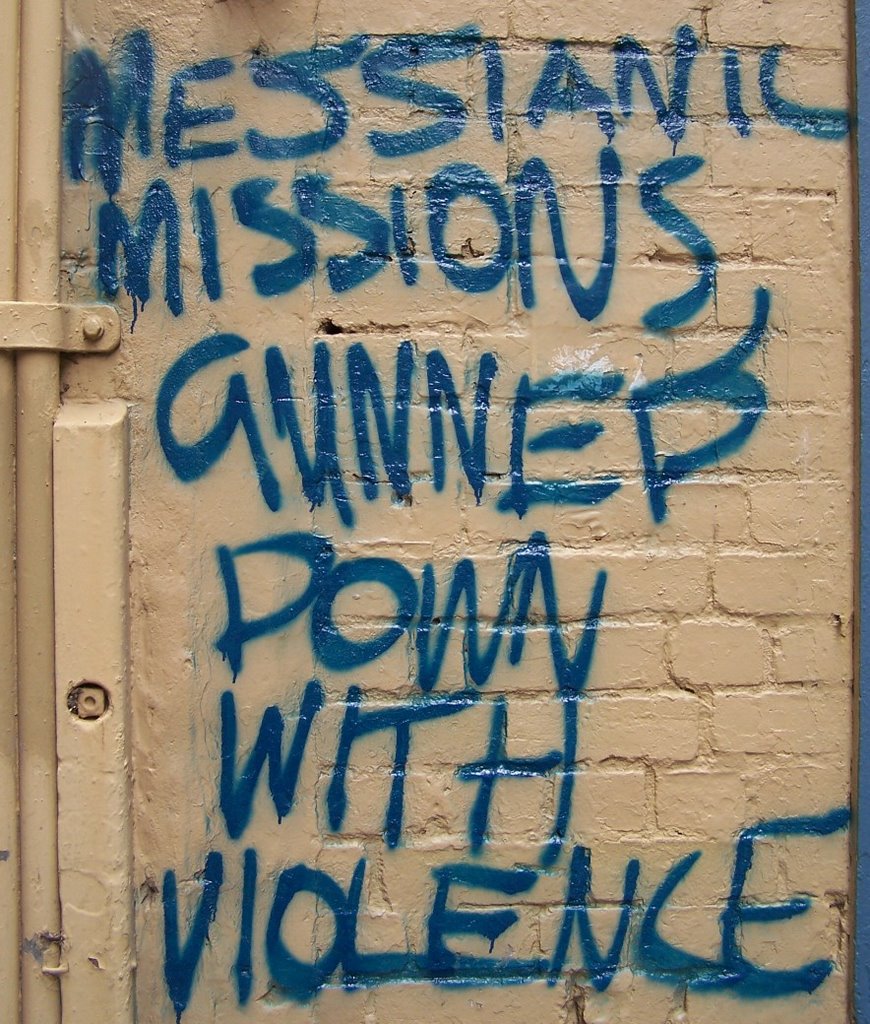
A Lenten message?

Graffiti in a lane off Little Collins Street, Melbourne, between Queen & William Streets

Friday, March 17, 2006

Operation Swarmer - No: Peace on Earth - Yes


- the biggest since the early days of the war in 2003.

This afternoon, Friday 17 March, 5.30 pm in Melbourne there will be a Troops out of Iraq Rally. The rally is part of an international weekend of protest to mark the 3rd anniversary of the invasion of Iraq.
The rally will be held at the State Library, cnr Swanston & Latrobe Sts, CBD. It is being organised by the Melbourne Stop the War Coalition. Information can be obtained by phoning 9639 8622 or emailing melbournestopthewar@yahoo.com.au
WE WANT PEACE ON EARTH
AND GOODWILL TO EVERYONE

Tuesday, March 14, 2006

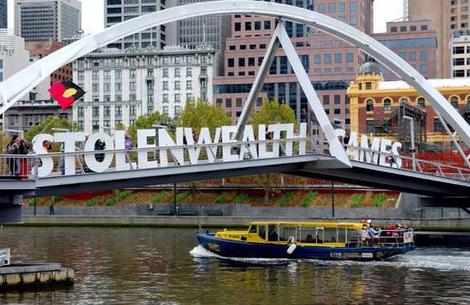
Stolen Wealth


Melbourne yesterday celebrated its annual Moomba Parade. To-morrow is the opening ceremony for the Commonwealth Games. In all this celebration and hoopla, those active people from ANTAR came to the party and gave us all cause for reflection. They lined up on a bridge in full view of the Moomba Parade and held up door sized letters and spelt it out across the Yarra - StolenWealth Games. Check out the associated website here.

Wednesday, February 15, 2006

Leunig unloved? 4

Leunig has been held up as an anti-semite in some quarters - and quite recently here in Melbourne. The problem is not with racism nor with bigotry nor anti-semitism. The cartoons in question portray an anti-war sentiment.

Empires survive on militarism - the American Empire of the USA no less than the British Empire or the Empires of other European nation states. Anti-war sentiment has never been welcome in the polity of empire and becomes punishable in many, if not most, societies in time of war. Australia is at war within the American hegemony. Israel is always at war with the Palestinians and watchful to the point of paranoia for anti-semitism and anti-zionism. Into this tangled web of paranoia, militarism, and misplaced ideology Leunig has fallen because of another's dishonesty and treachery. Anti-war sentiments and movements rarely find official acknowledgment. There has been no equivalent of the welcome home march for those who protested against Australia's participation in the Vietnam War. Yet this anti-war movement was significant for those who participated. It transformed my generation. It produced a generation of politicians many of whom are still scattered around the Parliaments of Australia. And, if this was not enough, many of us continued into the anti-apartheid movement to battle the Springbok tour of Australia and organise boycotts of South African products. I have never felt the need to read Mandela's biography - the anti-apartheid movement lived and worked in the shadow of his presence. Everyone loves Mandela to-day it seems yet few were around when the campaign was on. These two movements were and continue to be significant - yet little understood by the powerful in society, in a society dedicated to consumerism, material gain, and stratification by wealth and education.

It should be remembered there is, arguably, only one war in the last century which did not generate a widespread anti-war movement nor produce significant anti-war literature. This war was World War II. In this war, the evil and the enemy was clear from its political antecedents through to its conclusion. The anti-war literature of World War I is particularly significant from that of Vera Brittain through to Siegfried Sassoon. People of those generations felt like they had been hoodwinked. Young idealists had gone to give their all for their country only to see hundreds of thousands of young men used up as cannon fodder. While the anti-war movement of World War I was not replicated in World War II, war weariness was evident in the post-war election in the United Kingdom where renewal was at the heart of a nation who kicked out a victorious war Prime Minister in Churchill and sought a new world in the Britain's first Labour Government - a government which implemented the Beveridge Plan and introduced the Welfare State to the world.

Through our society runs the thread of anti-war sentiment which seeks to emphasise the productive and creative elements of the pursuit of peace and life in a humane society. It should not be misunderstood - nor should it be gainsaid. Nor should dishonesty and misrepresentation be allowed to bring it into disrepute.