Wednesday, November 26, 2008
New directions

Wednesday, June 18, 2008
It takes a village...

Wednesday, February 06, 2008
Seasons of the Soul: Ash Wednesday 2008

I draw aside to-day:
into the quiet, the reflection
of the pool of life.
I watch the disturbance,
the stone of my being
cast into the timeless pool…
ripples moving outward
from the centre
of the sunken stone…
circular disturbances
of small circumference
enlarging to a fading edge.
The rippling of my life
is energy into stillness
moving beyond its entry point.
The ripples, equilibrium disturbed.
The still centre sinks
under the surface.
Rippling circular to centre.
Never a straight line,
never trajectory altered.
The disturbance continues
outward…
Until, far from its centre,
it ceases.
Brigid O’Carroll Walsh
Ash Wednesday 2008
6 February 2008
© 2008
Monday, January 07, 2008
Water for beer but it's a drought in the garden
I reckon Miss Eagle can say without fear of contradiction that Denise Gadd is hopping mad. Denise blogs at The Age where she is also the gardening editor. Now the blog is in a bit of a hiatus for the silly season. Denise burst into the Opinion Pages of The Age with this piece to-day. Almost a year ago to the day, Denise was having her say with this piece.You will have noted, dear Reader, that Miss Eagle is promoting the petition, to which Denise refers, on her blogs. Go for it Denise, I say. Anyway can we send Tim Holding a ticket to a Permaculture design course for a New Year pressie? He clearly is not a gardener and has no sympathy for those who garden. I get mad when I think of all the water that it takes to make beer - and I don't drink a drop. I presume that Tim drinks his fair share - so how about giving me some leeway with my veges, Tim!
Monday, December 03, 2007
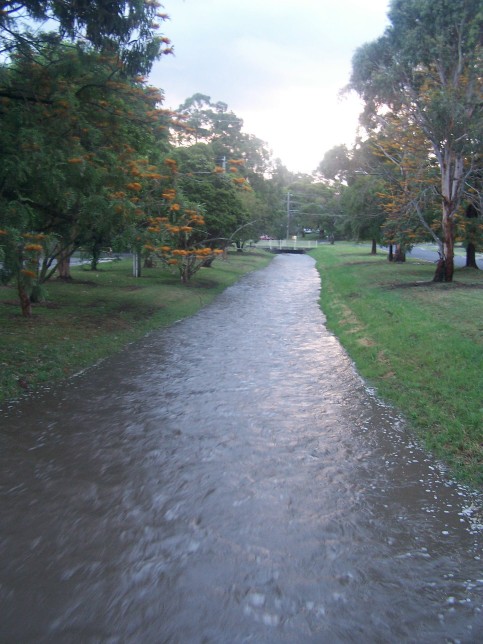
Water, water everywhere in the Outer East.
For the first time in three years, the creek in front of our house is full and flowing: flowing fast, in fact.
Water, edibles and the elderly in the vege patch
Here is some of Miss Eagle's vege patch & pots.
Water is at a premium in Australia - and Victoria is no exception.
This morning we got a very welcome drop of rain.
But water is an issue with veges.
We are warned that there will some food shortages this summer along with higher prices for fruit and vegetables.
So it makes a lot of sense to grow your own.
You can eliminate the chemicals. Go organic. Plant permaculture.
And get a lot of pleasure and good nutrition all at the same time.
But water is an issue and Marika Wagner wants us to join her in lobbying the government about our needs. Marika knows what she is talking about. She works at the marvellous Bulleen Art and Garden here in Melbourne.
Marika says:
Produce gardens provide us with the very fruit, vegetables and herbs we eat, and many of us have worked hard to create these gardens with much of our own time and money.
It's understood that keeping higher water use ornamental gardens and lawns can be seen as luxury items in times of water shortage, but forcing us to let our produce gardens become unproductive and/or die is an outrage. Only being able to water on two pre-specified days of the week is not the most efficient way to keep a garden alive and productive and can lead to stressed and unproductive plants, defeating the purpose of this type of garden. Produce gardens should be allowed efficient, mindful watering, when required.
Education to efficient water use, is the key to saving water for Victoria, not forcing gardens to dwindle & perhaps perish.
To be able to grow our own food:-
1) Saves water for Victoria, according to a study done by David Holmgren, co-founder of ‘Permaculture’, (Holmgren Design Services), efficient backyard growers can use only one fifth of the water compared to commercial growers per $ value of produce.
2) Saves up to 25% of greenhouse gases by eliminating ‘food miles’, this means our fruit and vegetables don’t use excess energies of ; being machine harvested, transported to sorting sheds, stored in cool rooms, transported to market, then to supermarket, lit up by fluorescent lights and then transported again to homes to be then stored again in the fridge, whilst losing vitality and freshness along the way.
3) Reduces the overall Australia wide use of biocides like herbicides, pesticides and fungicides. This is because home produce gardens are naturally quite biodiverse, therefore resilient, and easy to apply natural pest control methods to.
4) Brings people and families together outdoors to gain healthy organic produce, fresh air, exercise and an awareness to our connection with nature.I believe that it is our right to grow and monitor our own fresh, healthy, chemical free food in our backyards. I am asking for an exemption from current water restrictions or for introduction of more appropriate water rules for our important produce gardens.
So, dear Reader, please pop across here and sign Marika's petition. And then, when you have done that, please let all your friends know and get them to sign too. Let's make Tim Holding and the Victorian Labor Government sit up and take notice. Otherwise, civil disobedience?
Miss E also supports Kevin Walsh's idea for a new E level of restriction: for the elderly and edibles. How sensible.
Tuesday, October 30, 2007
Kruszelnicki seeks advice in the right quarters
Good friend of this blog, Denis at The Nature of Robertson, has taken on the role of adviser to a Senate candidate. Congratulations, Denis! Your depth and breadth of environmental knowledge is being recognised - and by a person acting in a most public and constructive way.Denis has acquired, through hard battles, a great deal of information about problems in the Sydney hinterland in relation to water, the environment, and local communities. Dr Karl Kruszelnicki who is standing as a member of the Climate Change Coalition, for the Senate in NSW has asked Denis for advice in this regard. Read all about it here.
Thursday, July 19, 2007
Brenda Niall: Witness and Advocacy
This week on Radio National's First Person, biographer Brenda Niall, is reading from her autobiography, Life Class. This morning she discussed the biography she did of one of Australia's great artists, Judy Cassab. Miss Eagle feels a sort of affinity with Cassab - on two occasions in her daily life she has gone to work each day to come face to face with a Judy Cassab. When Miss Eagle managed the Mount Isa Public Library, it was a very large portrait of Sir James Foots, a former Chairman of Mount Isa Mines Limited. Many years later, Miss Eagle worked in the Darlinghurst offices of Leon Fink, the well known Sydney art patron.
Her desk was directly below a Cassab nude.Friday, July 07, 2006
We must all be guardians
Miss Eagle's blogging mate, Denis Wilson, over at The Nature of Robertson has done numerous posts about the Kangaloon Aquifer and Sydney's profligate demands for water which see Sydney Water readying to rip-off the aquifers and catchments of the Southern Highlands to meet Sydney demands. This will have drastic effects on the environment and agricultural livelihoods in the beautiful Southern Highlands of NSW.Denis's own efforts and encouragement have now led to Karen Guymer setting up a blog dedicated to the issues. It is called, quite simply, Kangaloon Aquifer Issues.
It seems to be the nature of things to-day, on this planet, in this place, and in this time, that each of us has to become a guardian of our own environment. Bush is accused of prosecuting an "oil war". This may only be a precursor to the "water wars". Water and air are our very life. When we pollute them, when we rob them - we reduce our access to life. Can't we see that? Can we only see self-interest?
If you, dear Reader, are standing guard over your environment, particularly in regard to water and air issues, could you please be in touch with Miss Eagle and tell her about it? If you too have a blog to alert people about a particular environmental issue, could you please advise Miss Eagle because she would like to put a cache of environmental blog links on her side-bar to alert and encourage people. And just like the RSL says at 7pm every night "Lest we forget", perhaps we ought to look around us at what we value and what we wish to protect and say each day, at sunrise and sunset, "Before it's too late....."
Monday, June 05, 2006
World Environment Day 2006
Australia is the driest inhabited continent on earth. Most of Australia is classed as arid or semi-arid, with 80% of the continent receiving less than 600 millimetres, and 50% receiving less than 300 millimetres, per year.
Of all the water on Earth, only 3% is fresh. Less than a third of 1% is available to humans. The rest is frozen in glaciers, polar ice caps or deep within the Earth, beyond our reach.
Water is one of the most important natural resources we have. It is essential to our existence.
Since 1900, global water consumption has risen 10 fold. UNESCO has predicted that by 2020 water shortage will be a serious problem world wide.
As Christians, we are called to care for, and to share with all, the creation given by God. It is therefore a responsibility of the Church to show leadership in sustainable water management. Action is therefore being taken to raise the awareness of members of the Eastern Region of the Melbourne Anglican Diocese to this responsibility and to encourage an engagement in, and an acceptance of, the challenge concerning water usage by the Church itself and by Church members.
REFLECTION
As a people of faith we have before us the Great Commandment,
The commandment calls us into a relationship with our living world.
We have been offered a time to heal both ourselves and our environment by using this received and share knowledge, we are enabled to hand on our wisdom to those generations yet to be born and also to honour all those who have made this journey before us.
Loving God we thank you for this world of wonder and delight.
You have given it to us to care for, so that all your creatures may enjoy its bounty.
Saturday, June 03, 2006
The Great Water Takeover
The molecules of water in a single glass
The water you're about to taste
The water in you is between a' betwixt
The fountains spraying in the park
The water you cannot retain
Dr Verne N. Rockcastle
- You see, dear Reader, Heffernan is a farmer. Mark Vaile, Leader of the increasingly irrelevant agripolitical machine, the National Party, has expressed concerns about the state management of water. But, dear Reader, Miss Eagle is concerned that access to water is on the basis of equity and equality. She does not trust farmers or those who would create "markets" for water. Probably the biggest issue in The Bush - aside from drought - is a topic known as Property Rights. If you want to find out about Property Rights and farmers and water, read Paroo.
- Cubby Station is impeding water flow into the Murray-Darling and taking water for itself. Are Vaile and Heffernan going to stand up to the owner/owners of Cubby. Peter Beattie tried and was forced to back off by angry people in the Dirranbandi/St George area: typical National Party territory and the area of Nationals Senator, Barnaby Joyce.
- Miss Eagle's friend Denis of The Nature of Robertson will want to know how Sydney's water shortage will be addressed. He has posted extensively on the proposed drainage of the Kangaloon Aquifer in the Southern Highlands of NSW.
Miss Eagle is not the biggest fan of Paul Sheehan (he of the Opinion columns in the Sydney Morning Herald). She does not universally share his opinions although there are times they co-incide. Miss Eagle does think that his writing skills are excellent - so even when she doesn't agree with him at least it is interesting and delightful to read. With that qualification, Miss Eagle publishes in full his piece of Bill Heffernan. It is well worth the read. But just remember, Bill, Miss Eagle is watching to see if your actions match your words. You have one notch on your belt now. Let's see a few more.
Australia has the potential to become one of the most stupid, short-sighted, short-lived civilisations (for want of a better term) ever created. The nation could last little more than three greedy, mediocre centuries as an advanced economy, and two of those centuries have already passed. Compared with what's heading our way unless we mobilise as a nation, such passing obsessions as the Iraq war and the latest federal election are mere sideshows.
People keep talking about the historic "drought" afflicting the eastern states. It is not a drought. It is far more serious than that. Even if good rains come they are not going to change the fundamental problem. The weather pattern has changed. Having mined and altered and channelled and stripped the landscape for the past 150 years in an impossible attempt to re-create Europe, we can't even see the obvious - that when you profoundly change the landscape, when you destroy vast amounts of balancing energy in the soil and vegetation, you change the weather.
Gradually, with excruciating slowness, the full magnitude of our collective ignorance and arrogance is only beginning to come into focus. We saw a hint of this focus on Friday when the Prime Minister and five premiers - all except the Premier of Western Australia - gathered in Canberra to announce a belated national effort to address Australia's slow-motion disaster with the river systems and the over-allocation of water.
The process is going to make for some strange politics. Take, for example, Senator Bill Heffernan. He can see the disaster unfolding. And because he can see it unfolding, he is now to the left of St Peter Garrett when it comes to the environment. While Garrett is locked into the union-dominated Labor Party, Heffernan has moved to the left of Labor on big environmental issues. Take his views on that most totemic green cause, the clear-felling of old-growth forests in Tasmania, protected under the bipartisan Regional Forests Agreement:
"It's a disgrace," Heffernan told me. "They could end clear-felling of old-growth forests tomorrow. And they should. They are over-committing Tasmania's forest resources in a way they will regret in a hundred years ... And in their haste to clear the timber they waste and burn and haven't even done any work on the impact on the water system. Places like Launceston are having a dramatic change in the stream pattern. It could be a long-term disaster."
Yes, Wild Bill Heffernan, the Junee farmer, Irish-Catholic conservative and political knee-capper, who sits impregnably at the top of the Liberal Senate ticket for NSW in the next federal election. He also happens to be driving two Senate inquiries (he is chairman of the Rural and Regional Affairs and Transport Legislative Committee) into national water policy and sustainable forestry practices, and thus inevitably colliding with a raft of ugly statistics and ugly satellite images.
From this vantage point, and after a life on the land, Heffernan can see disasters, all different but all related, unfolding in every state. Sitting in his office in Parliament House, Canberra, late at night, he ticks off the big problems, using exasperated language which has not been vetted by his mate, the Prime Minister:
"In Tasmania, they burn everything that's there and 1080 [poison] them, it's just a mournful operation and the process of pushing down old-growth forests is a huge waste. They recover only about 10 per cent of the old growth as saw logs, the rest just goes to the chip mill."
He wants his Senate committee to consider a proposal to protect a further240,000 hectares of that state's high-value old-growth forests, offset by what he calls a "wall of wood" coming on stream from new plantations in Tasmania and Western Australia.
"In Queensland, the great national disgrace remains the water harvesting at Cubby Station [a huge cotton farm] which completely intercepts the water rights of downstream users ...
"In NSW, the over-allocation of the rivers and aquifers is a classic example of disastrous planning by governments of all persuasions. It's the same with the complete denial of the problems caused by water interception in plantation forests. It's happening in every state ...
"In Victoria, the La Trobe Valley aquifer is facing a potential catastrophe because of unsustainable drawing down of the water table ...
"In the Northern Territory, they have no brains and no experts when it comes to water management. The Government has decided to mine the arid aquifer, which means no one has learnt from the disaster of mining the Namoi aquifer ...
"In Western Australia, climate change and unsustainable water use has caused serious long-term problems for Perth's water supply."
The senator did not blink when I told him the noted environmental scientist Tim Flannery believed Perth's water shortage would become so severe the city could become "Western civilisation's first ghost metropolis".
"We need to get beyond denial," Heffernan said. "All governments. The only way for governments to get the political courage to act is for the public to be made aware of the gravity of our national situation. Friday's announcement by the PM and [Deputy PM] John Anderson and the premiers was real progress, a good start. They all know the Murray-Darling Basin has only 6.2 per cent of Australia's run-off but 70 per cent of Australia's water farming. They know that no matter how you do the sums, we need better technology, smarter water-farming, and the removal of some activity." He singled out rice growers and cotton farmers as having to "lift their game".
"It's a no-brainer that we need a new agricultural frontier in northern Australia, where the Timor Gulf and Burdekin catchments have 60per cent of the nation's run-off - 10 times more than the Murray-Darling - but are virtually untapped."
Australia controls the world's fourth largest expanse of land, sea and continental shelf. We should be an ecological superpower. Instead we have chosen, so far, to remain a European colony in the most insidious, dangerous way possible.

Friday, June 02, 2006
Selling out the nation
Prime Minister JB Chifley: opening ceremony: Snowy Mountains Hydro-Electric scheme, Adaminaby, 1949
National Archives of Australia (when will this be sold off?)
NAA: A11016, 821
Howard, Iemma and Bracks have decided to sell the Snowy Mountains Hydro Ltd., an icon of Australia's post-World War II development. This is a national shame which brings no glory to those involved. Glorious though is the letter sent by 56 prominent Australians to their Prime Minister begging him not to proceed with the sale. Miss Eagle publishes the letter below for all the world to see together with the honourable Australians who signed - many of whom are known internationally.
"The undersigned appeal to the Commonwealth to suspend the sale of Snowy Mountains Hydro Ltd. This iconic enterprise was a stepping stone on our path to nationhood and was seen by all the world as a marker of our aspiration. It is part of the glue that binds us.
Handing control of this central pillar of our water and power supply to those whose interests cannot be guaranteed to reflect our own, at a time of climate water and energy uncertainty such as we have never seen, is imprudent at best and could so easily end in bitter regret.
That the sale is proceeding, apace, with so little public understanding, is wrong. Such an action demands rigorous and transparent analysis by people of vision, with unquestionable objectivity, undistracted by unrealistic time limits, short-term budgetary considerations or vested interests.
We ask you to suspend the process to give pause for analysis and time for free and open debate of this manifestly non-partisan issue in all parliaments of the nation. Water is far too fundamental and precious a resource to be put in jeopardy with so little forethought.
A wise and sensitive response to the widespread and growing public anxiety about this sale would attest to the strength of our democratic system and serve to enhance the unwritten compact between parliament and people that has allowed this country to work so very well.
Our warrant for this appeal is that we are all so very fortunate as to have been born into or welcomed by this wonderful place we call home."
Signed:
Les Murray, Poet
Donald Hazelwood, Concertmaster Emeritus, Sydney Symphony Orchestra
John Bell, Actor, Bell Shakespeare
Siobhan McHugh, Author and Historian
Geraldine Brooks, Author
Julian Burnside, QC
Paul Barratt, Former Secretary, Commonwealth Department of Primary Industries and Energy
Andrew Buttfield, Civil Engineer
Alastair Mant, Author
Richard Leplastrier, Architect
John Anthony, Former Deputy Prime Minister
Ian Lowe, Scientist, President, Australian Conservation Foundation
Mick Dodson, ANU Institute for Indigenous Australia
Bill Hayden, Former Governor General
Jack Mundey, Former Union Leader
Tom Uren, Former Federal Minister
Cate Blanchett, Actor
Bernie Fraser, Former Reserve Bank Governor
Peter Cockbain, President, Institution of Engineers
Justice Marcus Einfeld, QC
Bob Wilson, Chief Commissioner of Water Resources
Jonathon Biggins, Writer
John Button, Former Federal Minister
Jeff Angel, Director, Total Environment Centre
Faith Bandler, Author
Bob Ellicott, QC
Ted Mack, Former Independent Mayor, MLC, MHR NSW
David Malouf, Author and Poet
Sheila Swain, Former Mayor and head of the Mitchell College of Advanced Education
Malcolm Fraser, Former Prime Minister
Gordon Samuels, Former NSW Governor
John Menadue, Former Public Servant
Max Talbot, Former Engineer, Snowy Hydro Ltd
Rachel Siewert, Senator
Peter Andren, MHR, Fed
Alison Broinowski, Writer and Former Diplomat
Craig Ingram, MLA, Vic
Peter MacDonald, Mayor, Former MLA NSW
John Hatton, Former MLA NSW
Vin Good, Former Snowy Commissioner
Tony Windsor, MHR, Fed
Robert Manne, Professor, LaTrobe University
Andrew Bartlett, Senator
Glenn Murcutt, Architect
Henri Szeps, Actor
Richard Wallace, Mayor, Snowy River Shire
Ian Barker, QC
Ian Frazer, Scientist, 2006 Australian of the Year
Paul Stephenson, Mayor, Goulburn
Richard Broinowski, Former Diplomat
Bob Ellis, Author
Russell Savage, MLA, Vic
Peter Sculthorpe, Composer
Lady Southey
Lyn Allison, Senator
Natasha Stott Despoja, Senator
Douglas Nicholas, Convenor