The Network

The Network
This blog is no longer updated. Please click the picture to hop across to The Network
Showing posts with label World Vision. Show all posts

Monday, April 10, 2006

Vaile, venality and vacuity


His written statement addressed 21 diplomatic cables about suspected irregularities in AWB contracts, and 21 times he said: "I have no recollection of receiving or reading this cable."

This is the summation of Mark Vaile's evidence given to-day at the Cole Inquiry into the oil-for-food scandal uncovered by the United Nations which showed AWB, Australia's single-desk wheat seller, was the biggest subscriber, through bribery sometimes known as 'facilitation fees', to Saddam Hussein's coffers.

It appears from to-day's evidence that - if the Cole Inquiry's Terms of Reference allowed it - it would be possible to draw a conclusion that Mark Vaile, Deputy Prime Minister of Australia, Minister for Trade and Leader of the National Party (a rural rump agriculturally based party), has been negligent in his administration of the Department of Trade.

The sort of support the AWB expected of and was provided by the AustralianGovernment was something worthy of Australia Inc dogma and politics. Tim Costello - CEO of World Vision, aid activist and brother of Australian Treasurer Peter Costello - suggested at a public meeting in Melbourne yesterday that official government aid money was diverted from AusAid to the benefit of AWB in its dealings with and in Iraq.

Now the taxpayers of this country, the defence forces of this country who have been sent to the mess of Iraq, those who expect ethical and responsible governance require answers. At this point of the inquiry, those of us on the outside looking in are left to think that Ministers including the Prime Minister and their Heads of Departments were asleep at the wheel at best and complicit or negligent in their attitudes to malfeasance at worst.

Oh, and by the way, Vaile's evidence carried a sting in its tail. A desperate throw of the dice, perhaps? A little insurance? He mentioned that he had no ministerial responsibility for the United Nations or its oil-for-food program in Iraq. The person who has will be next cab off the rank, to-morrow.

Tim Costello: AusAid, Flugge and AWB

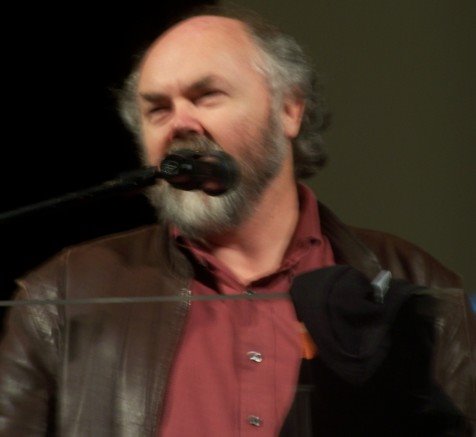
Tim Costello, speaking at the Melbourne Town Hall, 9 April 2006

God; politics right, left & centre; and the Wallis & Costello show

So you think that all Christians vote for right wing parties and think of political issues in terms of abortion, RU486, gay marriage and pornography. Not so. But, unless you follow the political processes of Australia quite closely, it can be hard to detect faith-based politicians and activists who take a broader view. They are there - and across party lines. Miss Eagle thinks of Bruce Baird in the Liberal Party and Claire Moore in the Labor Party who was one of that small group of women in the Senate who led the successful charge to make RU486 available to Australian women. There are others - but they are few. Not surprising really because, as a generality, Australians don't wear their faith on their sleeves as people do in the USA. Not that there aren't similar difficulties of awareness for broad-viewed people in the Republican and Democratic parties of the U.S.

How refreshing it is when one comes across US citizens of faith who don't support the Iraq war, who put the fight for poverty, justice, and equity above the abortion debate, and speak out on the biblical basis for these views. Such a person was in Melbourne yesterday: Jim Wallis of Sojourners. Jim, hosted by Micah Challenge and introduced by Micah Challenge International Council member and Tear Fund Executive Director Steve Bradbury, spoke yesterday at the Melbourne Town Hall.
Also speaking in support of Jim was World Vision's, Tim Costello.


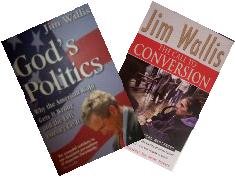
Jim is in Australia promoting the Australian edition of his book, God's Politics: why the American Right gets it wrong and the left doesn't get it.

Tim Costello wrote the Foreword for the Australian edition. Quotes

How did Jesus become pro-rich, pro-war and pro-America alone?

The good news is that the monologue of the right is over...Dialogue is always better than a monologue.

There are two great hungers in our world today, one for spiritual integrity and the other for social justice. And the connection between the two is the one the world is waiting for.

The churches ask for the edges of people's lives, and that's what they get, the edges. A whole generation of young people are looking for an agenda worthy of their energy and gifts, something big enough to give their lives to.

If I'm an unborn child I should stay unborn. Once I'm born I'm off the radar screen of the religious right - no child care, no support for mothers. It's pro-birth, not pro-life.

The choice is between hope and cynicism.

Cynicism is a buffer against commitment.

Hope is not a feeling nor a state of mind. Hope is a choice, a decision we make because of faith.

We are the ones we have been waiting for.

For a review of God's Politics which points out flaws as well as applauds, read Elizabeth Castelli's critique at Slate.

Friday, March 10, 2006

Pursuing Peace

Image hosting by Photobucket

Last night, I attended the launch of Gerard Guiton's book, The Growth and Development of Quaker Testimony 1652-1661 and 1960-1994, Conflict, Non-Violence and Conciliation. OK, I know. He knows. Yes, it's not catchiest title ever dreamed up for a book jacket - but he does have a good excuse. It is the book of the PhD.

Gerry's "first vocation" was teaching - in Australia and the UK. He has gone on since to spend his life immersed in peace and social justice: as Peace/Global Education Officer with World Vision Australia and as National Publications Officer for Oxfam Australia. Gerry is a Quaker with all the activity and concern that goes with the territory. He has been Friend-in-Residence at Woodbrooke, the Quaker Study Centre in Birmingham in the UK and has been the Henry J Cadbury Scholar at Pendle Hill, the Quaker Study Centre in Philadelphia in the USA.

Gerry's book examines the historical and spiritual underpinnings of contemporary Quaker approaches to conflict in third world military settings. Early Quaker Testimony was predicated on conflict on three levels namely inner (in which sin was purged); within the Society of Friends; and from hostile external forces. The Testimony also possessed a tripartite form instanced in the settling of conflicts within and beyond the Society; witnessing for justice and peace; and establishing mutual support systems.

Image hosting by Photobucket

Dale Hess (left) and Dave Bullen (right) who launched Gerry's book.

Contemporary Quaker Testimony, also arising from conflict and in tripartite form, is compared to Early Quaker Testimony to delineate convergences and divergences in theology, language use, approaches to authority, public witness and mutual support systems. Gerry specifically investigates South African Quakerism under Apartheid - between the Sharpeville massacre in 1960 and the all-party elections of 1994. This odyssey makes possible an analysis and discussion of individual and corporate experiences of conflict. Particularly noteworthy is Hendrik W van der Merwe, an international mediator who helped to facilitate the talks leading to the release of Nelson Mandela whom he knew. Quaker mediation is described along with conflict and dispute resolution techniques within the context of mediation-conflict theory.

Gerry expects that this book will benefit individuals and organisations involved in mediation, facilitation and third party interventions. It will also be of interest in the area of community, industrial, school, church and family dispute resolution.

Gerry's book can be accessed either for reference or purchase on

(a) http://www.mellenpress.com/mellenpress.cfm?&pc=8&catkey=48 and

(b)www.allbookstores.com/author/Gerard_Guiton.html